Once late May hits and it’s truly the beginning of summer, I start to feel nostalgic for reading novels by Sarah Dessen. The nostalgia was first nameable in 2024. My partner and I had just gone to the YMCA pool and then we got snow cones at the little snow cone shack in the parking lot and it all just seemed perfect. The sky was bright blue, his shirt was crispy white, the snow cone was artificially bright red, we both felt tired and smelled like chlorine and sunscreen. Sitting there with the person I loved and eating liquid sugar on ice felt like swimming in the good undertones of high school again. I remembered what it felt like to read recipes on Lauren Conrad’s website, try Pinterest workouts before “runfluencer” was a word, and oh yeah, to be excited about learning calculus.
I loved Sarah Dessen’s novels because her characters were always solving problems I wasn’t allowed to have. They navigated relationships with boys, made up with friends who they hadn’t talked to since elementary school, and invented new personalities for themselves to go with every variation of their name. By contrast, I was a serious-person-who-knew-my-purpose-which-was-fulfilling-my-role-as-a-woman-of-God-by-having-children-with-a-serious-man-after-getting-a-four-year-degree-as-backup-in-case-he-got-hit-by-a-truck. I already had the answers. In the algebra of life, I had found X*. Dessen’s characters were still looking. In my hubris, I called her novels “cupcake books,” something I was allowed to read every once in a while but couldn’t take seriously.
Life never works out how we think it will. I’m thirty now, half a lifetime later and I did marry the high school boyfriend who made me laugh, I only have one kid and he’s the best, I do have an actual career, and somehow it all feels just perfect. Because the kid wakes up so early, I’ve recently found myself regularly running again before 7:00 am for the first time since high school. Muscle memory has a way of jogging regular memories and I find myself thinking about posting my oatmeal on tumblr, wanting to reblog pictures of running shoes, and ditching big thoughts in favor of being myself without criticizing myself. Real life was turning out to be more like calculus; that is, not about finding X, but about describing how X changes.
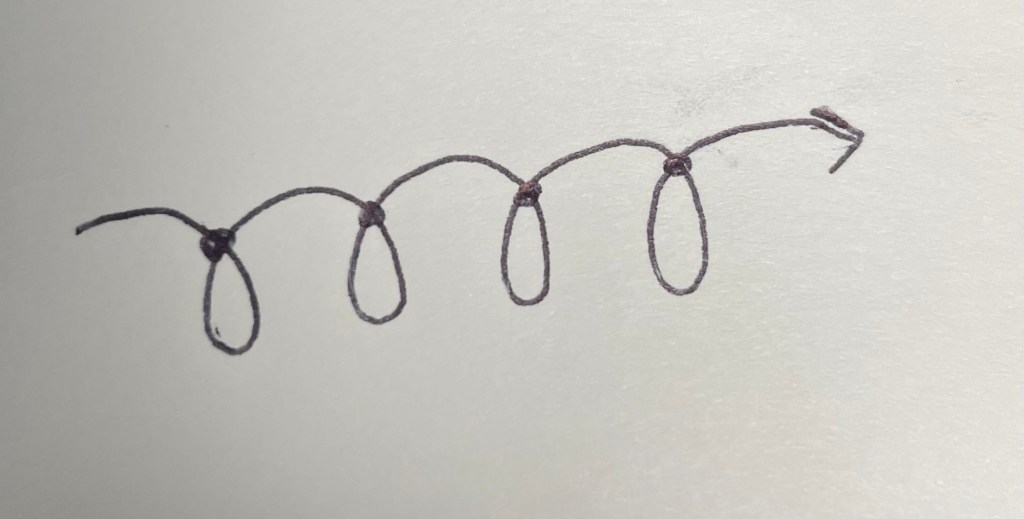
The one conspiracy theory I allow myself is that time is not linear. Instead, I believe it loops along in a chain, something like this:
After travelling into the future, we loop our way back for a minute and revisit some important point before heading on again for real, like tracking a single point on a wheel using parametric equations in calculus. This spring, I was responsible for scheduling a work event through a catering company and I always thought of one of Dessen’s novels when it came to catering companies. Early this summer, we took our first family trip to the beach, where so many of Dessen’s novels take place. I am making new friends, navigating new relationships that have sprung from being a parent, and realizing that the most beautiful life has come from what I previously thought was so unimportant. This time, when small changes try to make themselves heard over the scraping of my new tennis shoes on the concrete and gravel trails nearby my house, I am trying just to listen.
*Kate Malone from Laurie Halse Anderson’s Catalyst, basically.
Okay great, I think this is month 5 of doing a monthly reading post. I like this. It motivates me to finish books and think about them for 30-seconds, instead of the usual, thank u next. AND I can tell the internet what I think about them instead of bothering people I work with. Win. Win.
In other news, I ran a 5k in 27:29 today. I had a stressful job when I first moved to this city and I gained some weight and got pretty out of shape. There was a lot going on. Gaining weight isn’t the worst thing that can happen to a person, but for me it is usually a symptom of stress eating and not running and therefore not getting those necessary endorphin hits to regulate my emotions. Bad loops. So after getting a better job, I’ve lost some of the weight, and after cranking out 3.1 miles at an 8:40 pace, I feel like I’m back in shape and back myself again. So 10 points for Ravenclaw.
This month I finished Upon Silver Wings II: World-Record Adventure by CarolAnn Garratt about her flight around the world with Carol Foy. They raised money for ALS and broke the world record. The book reads like you are reading a sort of early 2000s email style journal written by the author – very conversational. There are a lot of pictures. Carol’s thoughts have kind of an ethereal quality about them. It isn’t in any way a guide to how to fly around the world or an in-depth study of the experience, just a description of the trip and the planning that went into it. The flight itself only took eight days, and if you’ve ever been in a small plane before, it’s a lot of kind of just being there an monitoring, so there is only so much you can say.
I also finished Dominion by Tom Holland. I’m glad I read this book and I should really take the time to develop better thoughts about it. The book describes Christianity as a cultural narrative and the book itself is, of course, a narrative. I think we miss so much how stories define our lives. There is a part of me that immediately rejects this idea of Chrisitanity-as-narrative; it’s like something a pastor would say or a Facebook post that would read “Christianity isn’t ‘just a story’, it’s real!” or “If it’s just a story, then what’s the point? So the Bible isn’t just a collection of stories! It’s science! And history!”. To be clear, I do believe Jesus rose from the dead, but I think that statements like that undermine the real power that narrative plays in our lives. I don’t know, maybe some people just exist without thinking about the whys, but I can’t do that. I need to be constantly putting pieces together. So anyways, I think this book did a good job for me of highlighting and stringing together a 2000-year cultural impact narrative. Good stuff.
Finally, I read Hannah’s Children: The Women Quietly Defining the Birth Dearth by Catharine Pakaluk. In short, it’s a qualitative economic study of why college-educated women who have five or more kids are having five or more kids. It was honestly a good and quick read. The book has a lot of strengths: long quotes from interviews, a focus on number of children (instead of the usual fundie garbage that shows up), and interviews from women of varying racial, age, and faith backgrounds. The last chapter gets a little dicey (wrote more about it here), but for the most part it stuck to it’s mission. As the author suspected though, not everyone will agree with the conclusions the women she interviewed have drawn – I don’t – I don’t think having eight kids is my “calling” (maybe more on that some other time), but Dr. Pakaluk did a great job of relating their stories and highlighting the positives of their amazing lives.
Next month I’m picking up reading around the world again with Hour of the Wolf by Andrius Tapinas (Lithuania) and I’ve got a couple Boring-A engineering and water books on the list too. And of course, walking and listening to Dune. We also started watching 3 Body Problem on Netflix, so that will have to get into the Audible library soon too…
So many stories, so little time, but so much life. ❤
Alright – Now that we’ve got the background out of the way, it’s time to read around the world. Passports and IDs out and ready everyone, shoes off, laptops in a bin…just kidding.
Here is an Instagram post I made on December 30, 2018.
The caption reads: “For 2019 (2020, 2021…) I am going to read a couple books from every country in the world. Let me know if you know any that are absolutely fantastic.” I got a few recommendations including The Alchemist by Paolo Coelho, In a Sunburned Country by Bill Bryson for Australia, Costa Rica: A Traveler’s Literary Companion by several Costa Rican authors, the book about how Singapore transitioned from a pre-industrial to a developed country, and Ghosts of Spain: Travels Through Spain and Its Silent Past by Giles Tremlett. I haven’t read any of those yet. So um, keep the recommendations coming. I wanted to start with books I already had, or books I had been meaning to knock out for a while.
So the obvious question is, how do I pick the books? I have a couple different methods. First, I’m not limiting myself to one book from each country. That means this project will take longer to complete, but, for example, I wanted to be able to finish up Les Miserables for France and also read a fun novel by a current author. Secondly, some books are particularly famous and associated with a certain country, like for example, Jane Eyre and England, or Anna Karenina and Russia. So I wanted to give myself the flexibility to read one of those and maybe also, again, a fun book by a current author. The main thing in choosing these books is that the author was born in the country, or has lived there for a significant period of their life, and the book mostly takes place in that country. So for example, while Aminitta Forna, the author of A Memory of Love currently lives in the UK, she spent much of her childhood in Sierra Leone and the book mostly takes place in Sierra Leone, so A Memory of Love counts for Sierra Leone.
The English major in me is sort of “triggered” by this project; after all, how could you possibly narrow down an entire country into one book? Is it possible to do this project without “essentializing”; that is, without unintentionally boiling down say, the experience of being British into one novel like Jane Eyre. Furthermore, is it possible to do this project without “Othering”; that is, without reading a novel of a country that is not my own and walking away with the distinct thought of “wow, people in this country are very different from me.” And finally, I am limited to those works which have been translated into English. I speak very limited Spanish, German, French, and I can read some Russian, but there’s no way I could read a book in another language. Maybe I could get through Harry Potter in Spanish. Maybe. While I acknowledge that reading a book in its original language is a much richer experience than reading one in translation, I do commend the work of translators who put so much work into staying faithful to the original.
So in short, I’ve decided to approach this project with some set intentions and most importantly, to recognize that I’m human and have limited time and resources to dedicate to this project. As much as I would love to spend the majority of my time sitting on my couch reading novels and learning languages, and the rest of it travelling the world, I cannot. So as I embark on this project, I want to acknowledge that every single country in the world has more than one person in it and therefore, has more than one story to tell. There are always going to be some experiences and lives of which I am unaware. Please, do this project yourself, and choose different books than I did.
Okay, enough navel gazing about the limitations of being a human in the world. Let’s move on to Project Structure.
Here is the first page of my Excel spreadsheet.
I started by going to Wikipedia and getting a list of sovereign states in 2018. I suppose now that that was six years ago and it will probably be another six years before I finish this project, I may need to update that. I have one sheet for each continent and I keep the list of countries on the right and the “official pages” on the left. I usually start by reading the Wikipedia page for the country and literature and honestly just googling “Literature in X country”. There are several websites which do a good job of collating popular books or “literature” from individual countries, such as the culture trip or fivebooks.com. I’m finding that sometimes there are web sites for individual countries which bring together translators, writers, etc., such as latvianliterature.lv, which, obviously discusses Latvian literature. So basically, I try to keep track roughly of which websites I look at and just kind of…look around…until I find a couple that I would like to read. Then I check to make sure the chosen books are available and reasonably priced, buy them, and get to reading.
The spreadsheet right now just notes the books and the dates I finished reading them, and the authors. I also list the books on this website. I have a space for comments on the spreadsheet, but I didn’t find myself making many comments, which is part of the reason why I’ve decided to bother with this series of blog posts. I found that it was sort of difficult to cram any sort of long thoughts into this small Excel block, but I didn’t want to write a formal essay because that’s boring…anyways here we are.
The first country I read was France. Looking back at the original page from 2019, I chose France because “Since I read a bunch of British and American Literature, or pieces of it, rather, while studying for the literature GRE and also just in general, and I’m partway through the French tree on DuoLingo, I’m going to start with France.”. So that is where I began. My original plan was to start working through Continental Europe and then up through Scandinavia, across to Russia…back down again, and around the world, but I found that going “next country to next country” like that was too rigid of a structure. Sometimes when it was 100 degrees outside where I live, I found myself thinking about cold snowy days, so I skipped to the Aland Islands. And last December I was thinking about somewhere warm, so I skipped to India. I borrowed a book from my sister for a couple years and wanted to give it back to her, so I skipped to South Africa. So while my “default next country” is still somewhere in Continental Europe, I’m flexible. Books are cheaper than plane tickets and I’m under no obligation to choose an “efficient path.” This is a journey of many years and many words.
Okay, so lets see, I think we’ve got everything now. The Instagram post that started it all, how I choose the books, and how I choose the country. Again I’d like to reiterate, this is a fun project, I’ve already learned so much and I’m really enjoying this exploration. You should definitely try it too. This study is broad and the purpose is to open doors, broaden my horizons, and create questions for me about living in our ~global society~ today.
Okay. That’s enough for today. Thanks for reading with me :).
I’ve thought a lot about (am thinking a lot about?) starting a YouTube channel where I document my ~reading around the world journey~. I’ve even gotten so far as to record the first video, decide the lighting isn’t great, find my partner’s GoPro, try and set that up…and then it stops there. It’s not something I want to do on a week day, and I don’t want to wear makeup on the weekend, and I don’t want to record myself when I’m not wearing makeup…alas. It is the little vain things in life that keep us from pursuing our dreams.
But also, I’ve started to put more brain power into my actual job, so maybe it’s okay that I’m not obsessing over a YouTube channel. And anyway, even if it’s not the most popular form of media, I can say everything I want to say right here, using the ancient technology of the written word. Maybe too this will force me to redo the blog (again), so that my posts are more nicely categorized. Anyways –
Part 1: Welcome & My Reading Journey
Hi everyone, I’m Ally, and welcome to this blog, Reading with Ally. Today, and for many days to come, we’re going to be reading a book from every country in the world. And probably several other books too. But before we take off around the world, we need to start at the beginning. We need to go back home, where our reading journeys began.
I have always, always been a reader. When I was four years old, my mom taught me to read with the Hooked on Phonics curriculum and I remember wanting to get good enough to read Chapter Books, specifically, the book with the girl and the horse on the cover. I’m pretty sure it was this one: Becky and Beauty by Mary Hooper. I remember it being blue, not yellow, but I was four years old, so maybe it was an older edition, or I could be remembering wrong, I don’t know, that was twenty-five years ago at this point.
In elementary school I read the classics (Tik Tok sound), and by that I mean Anne of Green Gables, Little Women and Pollyanna and all the appurtenant sequels, and of course Dear America, American Girl, Boston Jane, and The Royal Diaries. Elizabeth Tudor, Abigail Jane Stewart, Felicity Merriman, and Molly McIntire were my girls. By middle school, I kept an Excel sheet of every book I read, totaled the pages, and broke it down by genre (Figure 1).
Figure 1: Example from the Books I Have Read Spreadsheet.
You can see I read mostly historical fiction, but I made some exceptions for science fiction and fantasy. Eragon, Andy Buckram’s Tin Men (recommended by my dad), and A Wrinkle in Time were all very much enjoyed. Some books from that era that still stick with me today; that is, you know, the ones you think about totally unbidden, including The Silent Boy by Lois Lowry, The Green Glass Sea by Ellen Klages, and 13 Little Blue Envelopes by Maureen Johnson. I also occasionally think about A Long Way from Chicago by Richard Peck, particularly the scene where a crazy lady was running down the street naked, wrapped in a python. I read those over the summer at my Grandma’s house. I don’t think she would have let me read them if she knew about that scene, but alas, the damage has been done :).
I spent basically the entire summer before 7th grade inside on my bed, reading. I think now we call that “bed rot,” but in 2007 it was just called “laying on your bed all day reading.” I was at that age where my mom didn’t really want me exploring the YA and adult section yet, so I was still reading kids’ historical fiction books. I remember reading Mable Riley: A Reliable Record of Humdrum, Peril, and Romance by Marthe Jocelyn, and feeling strangely disappointed. It was a “good book,” funny, wholesome, hit the enthusiastic historical fiction girl ‘trope’ on the head, but I just remember thinking that I wanted more. I wanted a change of pace. I was tired of quirky Victorian girls and I was tired of sitting on my bed reading about them. Looking back now, I realize that I was beginning to grow up, and I needed new stories, new heroines, new uhhh….scope for the imagination…to steal a line from the OG quirky Victorian girl.
By high school, I was so busy with sports and homework and summer jobs that I couldn’t keep up the Excel spreadsheet. I would say that in general, I read darker books, such as The Book Thief by Markus Zusak, The Lottery by Beth Goobie, and A Day no Pigs would Die by Robert Newton Peck. My parents have said before that ~kids these days~ are depressed because they read depressing books, but I don’t think that’s true. I think ~kids these days, and kids when I was in high school~ are depressed and overworked for various reasons, Anne Helen Peterson and Alexandra Robbins said it better than I ever could. A Day no Pigs would Die was the first book that made me think critically about how we are connected to what we eat, but not in the pseudo-political supply-chain economic-systems way of thinking that a lot of the vegan/vegetarian books I would read later did. I think it was deeper than that; it was one of the first books, stories, narratives, that “touched me to my core” and changed something that is hard to put words too. It was a story of life and love and how hard they both can be.
OK. Enough of that.
High school was also my dystopian literature phase: 1984 and Animal Farm made an appearance, but also Unwind by Neal Shusterman. I also read a lot of Ayn Rand; all of We the Living, Anthem, and The Fountainhead, and 2/3 of Atlas Shrugged. Once there were no more trains in Atlas Shrugged, I kind of lost interest. I know people have strong opinions on Ayn Rand, and if I was reading her books for the first time now, as a 28-year-old, I’d probably say she’s “full of shit.” But in high school, her archetypal heroines gave me strong* women role models. Dagny was “who I wanted to be when I was 17,” and for better or for worse, my biggest takeaway from her work is that it’s okay to work hard, to own your work, and to advocate for yourself. I know *know* kkknnnooooww it’s a trend to hate on Rand, but, I think that take lacks nuance. She is famous for a reason. And, all that said, I do want to clearly state that I Do Not Think greed is good, money is the most moral thing ever, the government is always out to take down smart people, etc. Tbh I’d probably have kept the Rio Norte line up…depending on the intangible values provided to the country as a whole and whether or not there was a Federal subsidy program…etc.
I studied Civil Engineering in college, and that’s my day job today, but I also double majored in International Studies with a concentration in Global Literature. I chose that second major because it was the only humanities major, other than economics, which my college offered. Majoring in global literature was really fun; I took classes on Don Quixote, Russian Literature, South African Literature, European Folk and Fantasy, etc. I don’t have an incredibly deep commentary on that, except that I had a really great time, and – thanks to all my professors for their patience with my bad writing. Engineering school was hard, growing up is hard, this time is past. Probably the most influential books for me in this time period were On the Road by Jack Kerouac, Angle of Repose by Wallace Stegner, and Dakota by Kathleen Norris. Again, I know people love to hate On the Road, and they are right, Dean Moriarty leads a reckless life while women hold down the fort, but I fell in love with the sweeping speed of the American countryside, New York, Denver, and pies in North Dakota. Dakota by Kathleen Norris is a very different book, but it gave me similar vibes.
Angle of Repose is definitely a slow burn. I always feel weird saying I like it, because (spoiler alert) it’s about a guy with a bone disease and his cheating grandma, but I don’t know, Stegner’s prose is so, so…powerful. Probably because the novel is a metaphor for how we as the American people have managed the American West. Maybe. Maybe I’ll do a post just on that one.
So, this brings me to the most recent five or so years. If you’re still reading, wow, you must be really interested in what random people on the internet say about books. Anyways, I went to graduate school in English Literature and wrote a thesis on literature and engineering. It still has a long way to go if I ever wanted to make it into a concrete “idea”.
Writing is hard. This grad school time period is more recent than my elementary school spreadsheets, so I have yet to fully understand how it fits in my life and ~my reading journey~. I have no doubt that I’ll put the knowledge and skills I gained during that time to use throughout this series, but I don’t want to delve too deeply into a commentary of English graduate school and all that entailed. I guess what I want to say here is that I kept reading widely (Post-modern literature, Black literature, Literary Theory, Chaucer in Middle English), but I don’t know that I gained as many skills in articulating what I thought about that literature. I hadn’t written, or read for that matter, a good straight up no frills 5-10 page literary analysis paper since high school and early undergrad (my mental health really struggled in jr/sr year of undergrad). So I never really figured out how to take that “next step” to make really goodworthy of graduate level papers. I also didn’t get any better at literary anlaysis while writing engineering reports at a full time engineering job. Second, English grad school did have an interesting culture, very different from engineering, very kind up front saying out loud that everyone is an amazing human being, very brutal and critical of others on social media, like the volume of “awareness” and “calling out” infographics people shared were just insane. I did go to grad school from 2019-2021, so it was the time of Covid and the George Floyd protests, etc. The “calling people out for not posting” phase was just bizarre to me, even as someone who cares deeply about equity in the world.
All that said, each time I sat down to write some assigned paper for some required class, I found myself thinking of all the ways someone could critique my writing or thinking about what angles or marginalized groups I failed to address in this particular paper with this particular idea, instead of just….writing one paper with one idea. I didn’t (don’t) understand how to block out all the noise.
And so finally, here is today. I find myself reading mostly non-fiction, so I started this “reading around the world” project in part to get myself to read more novels. I don’t really go to the library on a slow summer day and browse the shelves reading the back of covers anymore, but instead I tend to find a book by beginning with an interest. For example, I’m perhaps overly interested in labor and the Midwest, so I recently read Boom, Bust, Exodus by Chad Broughton. I wanted to learn how to computer, so I read Code by Charles Petzold. Et cetera.
I also try to hit the big novels that I keep hearing people talk about. I did enjoy A Court of Thorn and Roses, although I haven’t read the sequels; I made it through one Colleen Hoover book, and I have a lot to say about Lessons in Chemistry by Bonnie Garmus. Maybe that one will get its own review someday. If someone takes the time to sincerely recommend a book to me or loan one to me, I try to find the time to read it. I am finding that there are just so many books in the world that even if you like reading, and you know people that like reading, you will inevitably struggle to talk to people about books because all of us have read different stories. One of my friends said, “there is art out there for everyone,” and she’s absolutely right. Reading expands both our horizons and our relationships, and even if my conversations with people about books never really get past “oh that one was good,” then, that is okay. Really, this project of reading around the world is about expanding horizons and learning some stories of people who have lived and grown up somewhere different from me.
Alright, that is enough for today. Thanks for reading with me :).
After cranking through several books in December and January, I relaxed a little in February. The slower pace wasn’t intentional…really, I just got distracted learning how to knit socks. Now, I have to fit a few rows of knitting into my 45 morning minutes. Really delays the pace of reading. Smh, hobbies be hobbying.
Anyways, for the month of February, I’ve been reading The Shadow King by Maaza Mengiste and A View of the River by Luna B. Leopold. The Shadow King is my novel for Ethiopia. I’m about halfway through, and liking it so far. It takes place during WWII, during the Italian invasion of Ethiopia. I don’t know anything about that section of WWII, having grown up in the US and therefore more familiar with the European theatre and the Pacific theatre (did you know the Japanese used a strategy called Island Hopping?). There are some intense, although not graphic, sexual scenes in this novel, so it is one you want to be prepared to read.
A View of the River is far slower paced. It’s something like a very short textbook and contains charts and graphs showing various river characteristics, such as bankfull flow vs. drainage area, how floodplain terraces are formed, et cetera. I picked it up because I’ve decided to get [more] serious about my career and you know, spend a little extra time outside of the work day getting the big picture view of things. As is typical with textbooks, some sections are easier to read than other sections. But on the whole, A View of the River is moving along with a good, steady flow.
Since we’re already six days into March, I’d better get these wrapped up pronto. Easier said than done when you have your regular job, a ceiling to fix, miles to run, dinner to eat, a cat to be fed (and cat vomit to be cleaned up). But it’s the little things in life, bits of progress every day, and there is no rush or schedule to finish these books. Moving forward, I’m finding books for countries along the route of United Airlines’ Island Hopper…I’ve been feeling those end of winter winters and vibing to the Moana soundtrack and thinking about travelling through the warm skies.
In the last two years, I haven’t read as much as usual because I was studying for my private pilot certificate. Now that goal is accomplished and I can return to my usual volume. I’ve been asked how many hours per day I spend reading. The answer is: “Not that many.” I usually read for 30-45 minutes in the morning and maybe for 10 minutes at night. If I’m on an audiobook kick, I’ll listen to one while I’m jogging (30-40 minutes) or on a long drive (1-2 hours). Usually though, 30-45 minutes a day is all the reading I do. The key is doing that 30-45 minutes every day. And, of course, picking up books that you’re interested in finishing.
And so begins a new year. In progress already is Determined: A Science of Life without Free Will by Robert Sapolsky. In the mail are The Boys in the Boat: Nine Americans and Their Epic Quest for Gold at the 1936 Berlin Olympics, Deep Water Passage: A Spiritual Journey at Midlife, and The Shadow King: A Novel. I saw the Boys in the Boat movie over Christmas break and it had that sweaty academic aesthetic that makes you want to run a 5k and write something smart after a long walk-about in nature. So I figured I’d keep that energy going. I heard about Deep Water Passage over Instagram. Maddymarq had a particularly insightful post about the beauty of the Midwest and she said this book shaped the direction for her life. The Shadow King will be my book for Ethiopia. I like reading books which are “out of season;” that is, it’s cold and snowy on the Great Plains right now, so it’s time to read about Africa. Finally, I got Magyk by Angie Sage to listen to while I’m running. I first read that series somewhere around 2010-2012 and I’ve never stopped thinking about it. So, it’s time for a revisit.
There’s always the temptation to order more books, but ordering books isn’t the same as actually reading them. All that ought to be plenty of content for January.